
Blog
Scroll down to view all posts, or view our archive to view blog post titles over time.
Questions every Family Caregiver Should Ask Themselves
Last week, you were living your life as usual and suddenly, a health crisis occurred for a loved one and you have been thrust into to a new role. The family caregiver. What does this mean? Are you ready to take this on? Am I capable? Why me? These are all valid and real questions that we have all had when faced with the role of caregiver.
As a caregiver advocate, I have learned through personal experience and the wisdom of others some tips on how to make the transition. But before you take on this role, I advise that you ask yourself some basic questions. As I share the top 5 questions to ask yourself and some tips, reflect on your answers and feel free to reach out in the comments below or contact me for additional support.
Last week, you were living your life as usual and suddenly, a health crisis occurred for a loved one and you have been thrust into to a new role. The family caregiver. What does this mean? Are you ready to take this on? Am I capable? Why me? These are all valid and real questions that we have all had when faced with the role of caregiver.
As a caregiver advocate, I have learned through personal experience and the wisdom of others some tips on how to make the transition. But before you take on this role, I advise that you ask yourself some basic questions. As I share the top 5 questions to ask yourself and some tips, reflect on your answers and feel free to reach out in the comments below or contact me for additional support.
Do you have any additional support, such as a supportive spouse or partner, a sibling, a family member, or a friend? Are they a positive or negative support?
Being a caregiver can be a 24/7 responsibility and should not be handled by only one person. Physically, emotionally, and spiritually, this role can become overwhelming if you attempt to do it all alone.
Have a meeting with all that have offered support. Share that although you are the primary caregiver, you will need help. This is the time to coordinate additional duties that they can assist with, doctor appointments, scheduled day out for caregiver, and a weekly social event for the stroke survivor.
Prior to discharge, the hospital’s Case Manager or Social Worker can provide local resources for support as well.
How do you plan to make time for yourself while caregiving?
Stress can manifest in many ways and how we handle stress varies. Some have healthy coping mechanisms such as exercise, meditation, or journaling, but others can be harmful such as overeating, abuse of alcohol or drugs, or isolation from others. It is critical to your well-being to acknowledge your stress and be open to positive stress management techniques.
A sign of feeling positive mentally is self-care. As caregivers, days and nights revolve around our loved one. Before you know it, your normal self-care routine is a thing of the past. I remember waking one morning and thinking, “When did I get so gray? Why is my hair such a mess? And my feet and toes are embarrassing.” These may seem minor, but when we look the best, we also feel our best. Taking care of you is not a selfish act and does not take away from your loved one’s care.
Part of what Rick lost was his ability to focus on others and me. It was emotionally painful that he was unable to identify or know what to do when I was struggling. This has been very difficult, and I would let myself go because I figured, “who cares?” But I learned I needed to care about and love myself.
Monthly Self- Care Checklist
Hair appointment for cut, color, or new style.
Manicure/Pedicure appointment.
Schedule lunch or dinner with a friend Plan a walk or exercise two to three times a week.
Plan an “out of the house” activity, i.e., museum, shopping, or a class of some kind.
Volunteer in your community. When helping others, the reward is that you are also helping you.
Laugh. If feeling down, call the person who always makes you happy and giggle.
Say “NO” to any requests that do not feed your spirit or promote self-care.
Reconnect with friends and family. Reach out every other day to one person.
Rest when you are tired–no excuses!
Where do you need to draw the line and say, “I can do this much and no more”?
Initially, you will try and do it all at the expense of your own well-being. We all have been in your shoes, and we are here to help. Assess what you can provide and what you want to do.
Make a list of what is needed, and the time involved. Take a day in the life of a caregiver and just write down a typical day for you. You will be amazed at all that is needed daily.
Next. Make a list of what you did just for you. A shower, eating, or a walk. Again, it is an eye-opening exercise.
Lastly, what can be delegated to another or is it a task that is needed daily or at all. I tended to over care for my spouse initially. Share this list with your support group and delegate!!!!
How do you plan to continue maintaining and improving your own physical and mental health?
Busy with the care of your loved one, it’s easy to forget that your health matters just as much now, if not more. Work with your healthcare provider to determine the best course of action to improve and then maintain your health.
Prevention and early detection of health issues will allow for the caregiver to make simple changes to lifestyle, start a new medication or have a procedure that can improve your quality of life.
Do you have children at home?
Depending on the ages of the children, this can either be helpful or not. Older children can be a great assistance, but they still need you as a parent. Assess where they are at, how they feel, and ask them their opinion on family caregiving.
I highly recommend that if you have children in the home, visit a family counselor prior to discharge and even during care giving to allow the family a safe place to discuss this new family dynamic.
Family caregiving can be a challenge but is also very rewarding and such an opportunity for growth for the caregiver and the stroke survivor. You will have moments of frustration but also tenderness, laughter, and love that you will never regret or forget.
For more information on what worked for us, check out “Stroke and the Spouse” available on Amazon or follow the code below to purchase.
Stroke Caregiver Connection…Because you care!
Feeling guilty when you get angry with the stroke survivor.
Why do we avoid being angry or expressing our frustration with our loved ones? GUILT
A common but very real issue is dealing with all the emotional and physical care of the stroke survivor. They have had a terrible health crisis and are trying to get back to where they once were. But it takes time or may not even happen, and we understand we need to be patient but “come on”, we get tired, angry and need to call them on their behavior.
Walking on eggshells, avoiding conflict, or holding all your feelings in is not healthy for either of you. Anger is a normal emotion and if not dealt with in a positive fashion can fester and lead to resentment, lashing out in a negative way and causing more divisiveness in a Care Partner/Stroke Survivor relationship.
Why do we avoid being angry or expressing our frustration with our loved ones? GUILT
A common but very real issue is dealing with all the emotional and physical care of the stroke survivor. They have had a terrible health crisis and are trying to get back to where they once were. But it takes time or may not even happen, and we understand we need to be patient but “come on”, we get tired, angry and need to call them on their behavior.
Walking on eggshells, avoiding conflict, or holding all your feelings in is not healthy for either of you. Anger is a normal emotion and if not dealt with in a positive fashion can fester and lead to resentment, lashing out in a negative way and causing more divisiveness in a Care Partner/Stroke Survivor relationship.
Why do we avoid being angry or expressing our frustration with our loved ones? GUILT
I know for a long time, I avoided any confrontation or having expectations because of the below reasons.
We are healthy and they have had a stroke, they are in a worse place. Only a “bad” person would get angry.
They can’t help what they are doing.
I am not angry at them but the situation and need to deal with this new normal.
We are told frequently we are so “strong” and feel that we must live up to this word.
I should be thankful they are alive and to lower my expectations.
But anger continues to eat away unless you do two things; develop positive anger management techniques and develop a plan with your loved one. These are the techniques I practice that seems to help me.
Walk away and assess the anger situation before acting. Ask the following:
What am I really upset about?
Is my LO capable of the action needed?
Am I overly tired and overreacting? (sleep solves a lot of anger issues)
Once I assessed and felt that it is an issue that my LO can impact – discuss.
Clearly state what you are angry about without yelling but rather talk calmly so that they can better understand and commu
Due to their stroke, they may not be able to problem solve or provide suggestions. Their response can be, “I am sorry, I will try to be better” not knowing what better is.
Share a choice of two possible actions that they can take to resolve the conflict. Make sure either choice will meet your needs.
If the conversation is not going well – take a time out, A few moments of quiet time might help you feel better prepared to handle what's ahead without getting irritated or angry.
Use humor to defuse anger. Lightening up can help diffuse tension. Use humor to help you face what's making you angry and, possibly, any unrealistic expectations you have for how things should go. Avoid sarcasm, though — it can hurt feelings and make things worse.
If your loved one does not participate or you feel that the issue is your anger at the situation caused by the stroke. Try the following.
Exercise daily. You don’t need to be a “gym rat” but just a walk around the block can make a big difference.
Journal your anger. When you write it down, you release that emotion and can close the page on that issue for the day.
Turn it over to God. He has big shoulders and can provide options if we allow and trust.
Talk to a counselor, family member or friend that will listen and not judge. You don’t need to hear you are wrong for feeling this way but rather a kind ear that can provide some positive solutions.
Let it GO!!! Once discussed or acted upon, Forgive yourself and your LO. If you allow anger and other negative feelings to crowd out positive feelings, you might find yourself swallowed up by your own bitterness or sense of injustice.
Stroke Caregiver Connection…Because you care!
When your loved one stops being social.
Over the past few weeks, we have travelled to see our daughter’s family in LA. Every minute was precious and filled with joy, but it can be very overwhelming for the stroke survivor and the Care Partner.
Due to their stroke limitations participation in activities and conversations are a challenge. What I experienced – My husband sat back and did not participate but observed. This was difficult because as the Care Partner, I was either making conversation for him or trying to explain his behavior. It is difficult to hear “He has really changed” “Why doesn’t he talk to us?” or watching Rick and the family not interacting as before. What I tell others “He loves you all and is content sitting back and watching” “Communication is hard for him.”
The feeling and realization that your loved one is slowly fading away from social situations is heart breaking. At home, one on one, He does well, although limited but he can engage. What causes this phenomenon and what can you do to improve. As we have traveled and had more social events, I have developed some strategies that I felt helped and want to share with you.
Over the past few weeks, we have visited our daughter’s family in LA. Every minute was precious and filled with joy, but it can be very overwhelming for the stroke survivor and the Care Partner.
Due to their stroke limitations, participation in activities and conversations is a challenge. What I experienced – My husband sat back and did not participate but observed.
This was difficult because, as the Care Partner, I was either conversing with him or trying to explain his behavior. It is difficult to hear, “He has changed,” “Why doesn’t he talk to us?” or watch Rick and the family not interacting as before. I tell others, “He loves you all and is content sitting back and watching.” “Communication is hard for him.”
The feeling and realization that your loved one is slowly fading away from social situations is heartbreaking. At home, one-on-one, He does well; although limited, he can engage.
What causes this phenomenon, and what can you do to improve? As we have traveled and had more social events, I have developed some strategies that I felt helped and want to share with you.
What causes your loved one to “fade into the wall” at social functions?
Factors that can cause speech and understanding issues with your loved one.
Fatigue from a lack of proper sleep or time zone changes when traveling. When tired, the slurring of words appears unbalanced or confused, and he gets frustrated more easily. Since they are often tired, it’s best if you don’t stay too long.
Outside of their normal routine, that is a comfort level at home.
Others are not providing adequate time to form their thought, find the words and respond.
Excessive stimulation in the social situation, numerous conversations happening, television or music, and
Aphasia and impaired motor skills are two of the main reasons for communication issues.
Aphasia is the inability to communicate related to the damage to the brain.
This condition can affect the ability to understand what is being said to them or asked of them. Aphasia may also impact the ability to read, write, and deal with numbers.
Impaired motor skills can be seen as slurred or garbled speech due to muscle weakness, motor programming, and speech-muscle coordination.
What helps my loved one…
Be patient. Remember, they are still aware and understand their limitations and can feel frustrated or embarrassed with the changes to communication.
Eliminate distractions. The SS brain must process input, but focus is a challenge when there are multiple distractions, and the multiple inputs can cause confusion.
Keep questions simple. Form your questions that require a yes or no. Do not ask questions that require multiple answers (1 question = one answer). If you need a decision (where to eat), do not ask open-ended questions but provide a choice of two responses that you are happy with.
Keep commands and directions easy. Only provide one step at a time. Memory might be impaired, reminded of dates or times.
Speak in a normal tone of voice and speak directly to them, not others in the room. Speak one person at a time. Use gestures, pictures, or other nonverbal cues to help with understanding.
Do not rush the SS to answer questions or comments. Allow time for the SS to process the information and form a response. My loved one shared that organizing thoughts and responding properly takes several minutes.
Resist the temptation to answer questions for them. This can be hard, but it is so important that you allow them time to gather their thoughts.
For more information on what worked for us, check out “Stroke and the Spouse” available on Amazon or follow the code below to purchase.
Stroke Caregiver Connection…Because you care!
Emotional Changes and Outburst
The emotional challenges began once home and remain an ongoing trial for us. Stroke affects the brain, and the brain controls our behavior and emotions. Rick experiences feelings of irritability, forgetfulness, carelessness, and confusion. Both of us experienced depression, anxiety, or anger. If you and your loved one are also feeling this way, discuss with your physician whether anti-depressant medication would be appropriate for your loved one and you.
Rick’s personality changed from being engaged in life to an attitude of apathy. He refers to it as being disengaged, that he is an observer in his own life. Apathy is a lack of interest, enthusiasm, or concern for life, feeling empty and not knowing why. His regular response to my questions about things became, “That sounds good. No big deal.”
A stroke is the “gift” that keeps on giving. When you think you’ve figured out how to handle something, the brain throws you another curve. My brain was overflowing with questions and emotions regarding Rick’s stroke that I was desperate to share with him, but he could not process. I had no idea if or when I could expect that he would again be my emotional partner.
The emotional challenges began once home and remain an ongoing trial for us. Stroke affects the brain, and the brain controls our behavior and emotions. Rick experiences feelings of irritability, forgetfulness, carelessness, and confusion. Both of us experienced depression, anxiety, or anger. If you and your loved one are also feeling this way, discuss with your physician whether anti-depressant medication would be appropriate for your loved one and you.
Rick’s personality changed from being engaged in life to an attitude of apathy. He refers to it as being disengaged, that he is an observer in his own life. Apathy is a lack of interest, enthusiasm, or concern for life, feeling empty and not knowing why. His regular response to my questions about things became, “That sounds good. No big deal.”
A stroke is the “gift” that keeps on giving. When you think you’ve figured out how to handle something, the brain throws you another curve. My brain was overflowing with questions and emotions regarding Rick’s stroke that I was desperate to share with him, but he could not process. I had no idea if or when I could expect that he would again be my emotional partner.
What emotional changes can be experienced?
Depending on what part of the brain that the stroke damaged, will make a difference on the emotional/personality changes experienced. The good news is that many changes caused by a stroke tend to improve over time. So, time is on your side.
Personality changes that may occur; Not feeling like doing anything, being irritable or aggressive, being disinhibited – saying or doing things that seem inappropriate to others, or being impulsive – acting without thinking, and doing things that are not safe or are not appropriate.
As with each brain each mood response can be different and unpredictable. Depression and Pseudo-Bulbar affect are all too common. The site below shares some great information. To learn more, log on to:
Post Stroke Mood Disorders | American Stroke Association
Studies suggest that simply having a stroke increases the risk of anxiety, depression, or both. Research indicates that PBA is more common in survivors of brainstem stroke, but it can occur with other types of strokes too. Depression affects between one- and two-thirds of stroke survivors. It's characterized by feelings of overarching sadness, lack of pleasure in old activities or changes in eating and sleeping patterns. Anxiety occurs when a survivor focuses on worries and concerns. Anxiety affects about 20 percent of survivors. PBA is characterized by a mismatch between feelings and expression, like laughing at a funeral or crying at a joke.
It's not uncommon for survivors to experience all three mood disorders. The good news is that treatment is available. For depression and anxiety, one of the best treatments is counseling or therapy with a licensed mental health practitioner. Caregivers should encourage their loved ones to get assessed. If they're reluctant to see a mental health professional, they might be willing to see a pastor, priest, or rabbi.
What therapies are available?
When your loved one starts to have problems with emotions and outbursts, the first step is to have them evaluated. This will determine the root cause of the issue. It could possibly be a reaction to medication or a temporary situation.
Solution Focused Therapy -SFT is future-focused and goal-directed, and centers on solutions instead of the problems that bring people to therapy. It’s also called Solution Focused Brief Therapy and Solution Building Practice Therapy.
Problem Solving Therapy-PST is a brief psychological intervention or “talking therapy” that’s typically four to eight sessions. Problems are identified through collaboration, and the therapist teaches the person a structured approach to solving them.
Cognitive Behavioral Therapy-CBT focuses on examining the relationships between thoughts, feelings, and behavior. By exploring thought patterns that lead to self-destructive actions and the beliefs that direct them. The therapist and individual actively work together toward recovery.
Attitude and Commitment Therapy -ACT (also known as Acceptance and Commitment Therapy) teaches people to "just notice," accept and embrace their thoughts, feelings, sensations, memories, and other private events (especially unwanted ones) instead of trying to better control them.
Interpersonal Therapy- IT focuses on interpersonal relationships by improving the way the depressed person communicates and relates. Techniques help the person identify emotions and their sources, express emotions in a healthy way and deal with emotional baggage from past relationships.
Mindfulness Therapy-MT (also called Mindfulness-Based Cognitive Therapy) helps those who suffer repeated bouts of depression and chronic unhappiness. It combines the ideas of cognitive therapy with meditative practices and attitudes based on cultivating mindfulness. The goal is to become acquainted with the mental states that often characterize mood disorders while learning to develop a new relationship with them.
Written by American Heart Association editorial staff and reviewed by science and medicine advisors.
How and what to share with family and friends?
As emotional and personality changes occur it is important to keep family and friends in the loop. Share what you are seeing and the plan for your loved one. Their support will be critical to you and your loved one’s health. Here are some tips on how they can assist you.
· Ask that they share their observations. You are with your loved one daily and so subtle changes can be missed or thought of as if that is just them.
· Activities and mental stimulation are critical to cognitive impairment. Invite the loved one out and allow them time to talk and share what they are thinking. Please be patient, it can take several minutes to form their thoughts or words to share.
· Patience with the outburst and attempt to redirect the stroke survivor.
· The primary help is for the Care Partner. Typically, they are the brunt of the outburst. Provide them with time away from the situation, allow them to vent, and provide encouragement.
Tips for the Care Partner
Each day is a new day, never knowing what to expect when I wake. I must focus on what personality remained and what had changed. It was an experiment to find the positive each day, and most days I couldn’t. After several weeks, Rick shared how much he appreciated all that I had been doing for him and said he didn’t tell me enough. That positive feedback was a life changing moment for me.
Poststroke, my identity became Rick’s Care Partner. He needs so much support from me. He becomes angry that he cannot do things for himself and at times I am the focus of the frustration. Being acknowledged by him made me feel noticed and that I was vital to the recovery. There are no simple solutions to the emotional changes, just small adaptations.
Staying positive allows me to try new approaches and to find new solutions. But staying positive, especially when they are upset or blaming you for their life change is not easy. Your feelings of worry, anger, frustration, or sadness are very valid and MUST not be discounted. Practicing cautious optimism may strike the right balance.
Ultimately, the best way to cope with the changes is to view life after the stroke as the recovery process and not as the end of life. It may feel like the end of life but it really is the beginning of a new life chapter. The key is working together with the stroke survivor. You need to provide honest and direct feedback. Allow them a sense of control and involvement over the life plan for the two of you.
What helps me…
· Share your grief with a support group. Family and friends love you both and are also dealing with the changes they see in the loved one. It is important to find a group for you. Individuals who are in the same boat and do not know your loved one.
· You feel responsible for them 100% and sharing changes falls to you. These are tough conversations. Talk to your health provider alone and then together discuss with your loved one. This softens the anger and sadness that they project onto you.
· Have a family meeting where everyone can share their observations with you, this will allow you to not feel so alone. Then together develop a plan to share with the loved one. The key is that they do not feel ganged up on. I recommend smaller conversations, with one child or friend at a time.
For more information on what worked for us, check out “Stroke and the Spouse,” available on Amazon, or follow the code below to purchase.
Stroke Caregiver Connection…Because you care!
Dealing with Cognitive Changes
For many months, my husband’s health has had expected changes due to the stroke and underlying health issues, but they have been manageable until now. Over the last few months, as many have experienced, changes have occurred and we as Care Partners need to adapt to keep our loved one and others safe.
Over the next four weeks, I will be addressing cognitive changes, emotional changes, communication changes and physical changes such as driving.
This week let’s start to tackle cognitive changes that you may see, when to address with a health professional, how to discuss with your friends and family and tips for the Care Partner.
What is a cognitive change?
When your loved one starts to have problems with memory and thinking, this is considered a cognitive problem.
For many months, my husband’s health has had expected changes due to the stroke and underlying health issues, but they have been manageable until now.
Over the last few months, as many have experienced, changes have occurred, and we as Care Partners need to adapt to keep our loved ones and others safe.
Over the next four weeks, I will be addressing cognitive changes, emotional changes, communication changes and physical changes such as driving.
This week, let’s start tackling cognitive changes you may see, when to address them with a health professional, how to discuss them with your friends and family, and tips for the care partner.
What is a cognitive change?
When your loved one starts to have problems with memory and thinking, this is considered a cognitive problem. Some of the most common problems are…
Concentration problems
Memory problems
Planning and Problem-solving
Problems moving or controlling your body (apraxia)
Problems with movement and finding your way around (visual perception)
Confusion and denial (anosognosia)
Problem recognizing things (agnosia)
Problem recognizing things on one side (spatial neglect)
Depending on the site of the stroke and residual damage, the above may be seen at the time of the stroke, and your loved one is receiving therapy to manage it.
The concern is when the above changes appear new for your loved one. We are 2 ½ years post-stroke and have begun to see cognitive changes. Numerous factors can cause the changes, so you must share what you have witnessed with your physician and neurologist.
With us, some of the changes have been subtle and I can see that the changes are part of the aging process. The concern is when the changes impact their activities of daily living and or become an unsafe situation.
When to contact your physician or need to call 911?
Your loved one has had a previous stroke, but a second stroke can occur. To quickly evaluate use the following acronym:
F — facial drooping: People should ask the individual to smile to see if it is uneven. They can also ask:
Is one side of the face drooping more than the other?
Is one side of the face numb?
A — arm weakness: People should ask the individual to raise both arms. If they are unable to raise one arm, or it lowers more than the other, it is a symptom of stroke.
S — speech difficulty: If a person has slurred speech, it could mean they are having a stroke.
T — time to call 911: If someone shows signs of the above, people should call the emergency services.
Once it is assessed that this is a non-emergency, follow the guide below on when to discuss changes with your physician.
Contact your MD when you first see a change. Document what you have observed, the time of day, and any precipitating factors such as travel or lack of sleep.
The American Heart Association provided the below information on their site - Cognitive impairment after stroke is common, and early diagnosis and treatment needed | American Heart Association
Statement Highlights:
More than half of people who survive a stroke develop cognitive impairment within the first year after their stroke, and as many as 1 in 3 may develop dementia within five years.
The high risk of cognitive impairment and dementia after a stroke suggests early screening is essential for determining initial treatment, such as multidisciplinary care, cognitive rehabilitation or increased physical activity. It’s also important to assess stroke survivors for cognitive changes over time to offer appropriate treatment modifications and support for longer-term care.
Cognitive impairment after a stroke may fluctuate, particularly during the first six months after the stroke.
More research is needed to help identify which stroke survivors are most likely to develop cognitive impairment and to help develop culturally relevant screening and management techniques.
How and what to share with family and friends?
Keeping family and friends in the loop is important as cognitive changes occur. Share what you are seeing and the plan for your loved one. Their support will be critical to you and your loved one’s health. Here are some tips on how they can assist you.
Ask them to share their observations. You are with your loved one daily, and so subtle changes can be missed or thought of as if that is just them.
Activities and mental stimulation are critical to cognitive impairment. Invite the loved one and allow them time to talk and share their thoughts. Please be patient; it can take several minutes for them to form their thoughts or to share their words.
Don’t assume they have nothing to say. They become embarrassed with the changes and may choose to watch the world go by versus engaging.
Topics of discussion that were so common to them may no longer be. For example, trivia for my husband was a go, but now he must think about it and gets embarrassed when he can’t remember the answer quickly.
Play board games or cards; this is a great activity and keeps their minds active. For me, winning is no longer the objective but that he can participate.
Tips for the Care Partner
As the Care Partner, the grief over your loved one’s changes is overwhelming. I want to think or pretend that it is all due to the aging process and we are all experiencing cognitive changes, but the fact is that these issues are above and beyond aging.
What helps me…
Share your grief with a support group. Family and friends love you both and deal with the changes they see in the loved one. It is important to find a group for you. Individuals who are in the same boat do not know your loved one. You may also consider contacting a carepartner advocate that can help guide you through this experience.
You feel responsible for them 100%, and sharing changes falls to you. These are tough conversations. Talk to your health provider alone and discuss with your loved one. This softens the anger and sadness that they project onto you.
Have a family meeting where everyone can share their observations with you; this will allow you not to feel so alone. Then, together, develop a plan to share with the loved one. The key is that they do not feel ganged up on. I recommend smaller conversations with one child or friend at a time.
For more information on what worked for us, check out “Stroke and the Spouse,” available on Amazon, or follow the code below to purchase.
Stroke Caregiver Connection…Because you care!
Financial Resources for Family Caregivers and Care Partners
Financial concerns are one of the top stressors for your loved one and for you as the Care Partner. I know that when my husband became ill, I needed to retire. This was not planned but as we know life changes and we all must adjust. I am NOT a financial expert or qualified to give advice, but I can share some general information provided by Medicare and AARP.
For individual support and guidance, please contact a financial consultant.
Resources available…
AARP: Getting Financial Assistance for Caregiving Is Not Easy — but It's Possible
Financial concerns are one of the top stressors for your loved one and for you as the Care Partner. I know that when my husband became ill, I needed to retire. This was not planned, but as we know, life changes, and we all must adjust.
I am NOT a financial expert or qualified to advise, but I can share some general information provided by Medicare and AARP.
For individual support and guidance, please get in touch with a financial consultant.
Resources available…
AARP: Getting Financial Assistance for Caregiving Is Not Easy — but It's Possible
How to Get Financial Assistance for Caregiving (aarp.org)
Oct 21, 2019 · There are resources for families who need caregiving help You Can Get Paid as a Family Caregiver Medicaid and veterans’ programs can help alleviate the financial burden of family caregiving
Free hotlines
Nonprofit organizations such as AARP have toll-free support lines to provide answers to questions, make referrals and point to resources for caregivers.
877-333-5885
7 a.m. to 11 p.m. ET weekdays
Spanish language: 888-971-2013
also 7 a.m. to 11 p.m. weekdays.
800-272-3900
advice on Alzheimer's and other dementia
24 hours a day every day.
866-901-4858
advice on dementia, finances, and senior housing
7 a.m. to 11 p.m. ET
USA.gov…
Get paid as a caregiver for a family member | USAGov
If someone with a disability already receives Medicaid, their state may allow a family member or friend to become a paid caregiver. Many states call this a consumer-directed personal assistance program. Each state has different requirements and rules. Contact your state’s Medicaid office for more information.
Some government programs pay family or friends of people with disabilities to help with daily activities including personal care, giving medicine, cooking, cleaning, and more.
State Medicaid programs
If someone with a disability already receives Medicaid, their state may allow a family member or friend to become a paid caregiver.
Many states call this a consumer-directed personal assistance program. Each state has different requirements and rules. Contact your state’s Medicaid office for more information.
Long-term care insurance
Some long-term care insurance policies allow family members to get paid as caregivers. Contact your insurance agent and ask for written confirmation of benefits.
Veterans’ programs
There are two programs available for veterans:
The Veteran-Directed Home and Community-Based Services program offers veterans a flexible budget. With the help of a counselor, veterans may be able to hire a family member to help with daily living and activities.
Aid and Attendance Benefits program provides monthly payments and a monthly VA pension for qualified veterans and survivors. These benefits help cover the costs of a caregiver, who may be a family member. Find your area’s VA pension management center to see if you qualify.
LAST UPDATED: December 6, 2023
Again, I am not a financial advisor, but the above information was helpful and hopefully gets you on the right path.
For more information on what worked for us, check out “Stroke and the Spouse” available on Amazon or follow the code below to purchase.
Stroke Caregiver Connection…Because you care!
Clues on what your loved one is thinking.
As a caregiver, we can get so focused on the needs of the loved one we are caring for that we never really ask “What are you experiencing, emotionally” When I was writing “Stroke and the Spouse”, my husband shared what it was like from his perspective. This opened a new avenue of conversation, a valuable perspective. I won’t share the whole chapter, that is in the book, but I would like to share his “Helpful Tips for the Caregiver.”
Point of view from my loved one…
Life had presented me with circumstances that required me to be totally self-centered. Things were happening to me and regardless of whether I was prepared or not, I was forced to deal with them. Only later did I look back and realize what I put my spouse, family, and friends through and there will be guilt. Leaving Lana alone to handle everything made me feel guilty; guilty about relying on friends to do simple things for me, even though they’re doing exactly what I would do if the circumstances were reversed. I felt guilty about interrupting my children’s lives. I felt guilty about being angry with God. Eventually, though, I came to realize that I did not cause this. It is merely the situation it has forced me to endure. It’s no one’s fault. So, I love my spouse and appreciate him for all he has done and will do for me on this journey. I’ve embraced my family and friends and tried to thank them for all they’ve done. And I thank God for having given me another chance at life.
As a caregiver, we can get so focused on the needs of the loved one we are caring for that we never really ask, “What are you experiencing, emotionally?” When I was writing “Stroke and the Spouse”, my husband shared what it was like from his perspective. This opened a new avenue of conversation and a valuable perspective. I won’t share the whole chapter in the book, but I would like to share his “Helpful Tips for the Caregiver.”
Point of view from my loved one…
Life had presented me with circumstances that required me to be self-centered. Things were happening to me, and I was forced to deal with them regardless of whether I was prepared. Only later did I look back and realize what I put my spouse, family, and friends through and there will be guilt.
Leaving Lana alone to handle everything made me feel guilty, guilty about relying on friends to do simple things for me, even though they’re doing exactly what I would do if the circumstances were reversed. I felt guilty about interrupting my children’s lives. I felt guilty about being angry with God.
Eventually, though, I came to realize that I did not cause this. It is merely the situation it has forced me to endure. It’s no one’s fault.
So, I love my spouse and appreciate him for all he has done and will do for me on this journey. I’ve embraced my family and friends and tried to thank them for all they’ve done. And I thank God for having given me another chance at life.
Helpful Tips for the Caregivers
God blessed me when I had my stroke with Lana. She was very involved in my care and took great care of me. She was patient and supportive as I began my rehabilitation. She was excellent in caring for me during this time, but I observed others who were not as fortunate because their spouse didn’t have the same skills as Lana or maybe didn’t know what to do. So, as a third-party observer, I’ll try to give some pointers on how to deal with us.
Be patient with us
I have spent my entire life as an active and vibrant human being. And then, one day, everything changed. I still remember how life used to be and how I used to be. I am trying to accept that my mind still says I can do things, but my body has different ideas. Things that were easy for me and done with no thought now appear very complex.
I lose focus easily. When I appear to be searching for a word or something to say to answer a question, wait. If interrupted, I must think all over, and if you jump in and answer for me, I become frustrated and more isolated.
I used to participate in conversations, and I still remember how that goes. I am trying to get back there.
Be Kind
I saw a woman at rehab who came to pick up her husband. He had difficulty getting his coat on, and she constantly berated him for not doing enough to help her. I felt that nothing he did would ever make up for what she had to endure.
Remember, he and I did not choose for this to happen, and this is, unfortunately, the “worst” part. We still love you and remember the person we first fell in love with many years ago. We are sorry we are putting you through this.
Be supportive
While I was not starting at square one, it has set me back a long way. So, recognize my victories when you can, even if it is as simple as learning to stir coffee again.
There was another woman at our rehab center who had suffered a major stroke and lost most of the use of her right side along with a lot of her speech. Her husband came every day to pick her up.
One day, when he came in, she sat up and sang “Happy Birthday to You.” You could have heard a pin drop while she sang, and I don’t remember if she sang it very well, but when she finished, the place erupted in cheers. As the saying goes: There wasn’t a dry eye in the house. Celebrate accomplishments no matter how small they may appear.
Be positive
I have been susceptible to depression. I don’t mean to be a drag on finances, family, or friends. The caregiver needs to be attuned to the patient.
My depression manifested as apathy; I just didn’t care about things anymore. Lana noticed this and along with my physician, we addressed it.
When depressed, it’s hard to recognize depression, and when I am apathetic, it's hard to recognize apathy. It was important for everyone to look for the signs of depression in me, as this could hinder the rehabilitation process.
Please keep us safe
Despite what everyone might say to the contrary, I felt I was a burden, I didn’t want to be. In my mind, I remembered what I could do before and would try to do things (like drive) before I was ready. I needed to remember that my coordination was off, my reaction time slowed, and my muscles were weaker than ever.
Lana needed to save me from me so I didn’t experience some major setback like a fall or an accident. I was frustrated that things were not proceeding as fast as I expected. I would become angry with Lana because I thought she was holding me back. When I became angry, I hope she remembers the previous section: I am sorry.
Laugh with us and keep loving us
I can remember twenty years ago, but not last year. I guess as my brain is healing, it must prioritize data. All my life, I have had wonderful memories. Sometimes, to my detriment, I would remember things from as far back as grade school.
I cannot fully express the frustration of not being able to trust something you have always relied on. So, when I vent my anger and frustration, know that it is not you I’m angry with and that I am sorry.
Lana is the love of my life, and I know I cannot get through this without her. My sense of touch is different, and I feel things differently, but I wanted Lana not to stop reaching for me. Even if I didn't say so, I needed to know she was there. I needed to have normal conversations, even if it took a little longer to be understood. Even though everything felt so serious, I needed to laugh at the world and us. Above all, I needed to feel that there is hope that I would return to some sense of normalcy, even though that may take a long time. This life is a journey, not a destination, and I am so happy that Lana is on that journey with me, even if we can’t say it.
For more information on what worked for us, check out “Stroke and the Spouse” available on Amazon or follow the code below to purchase.
Stroke Caregiver Connection…Because you care!
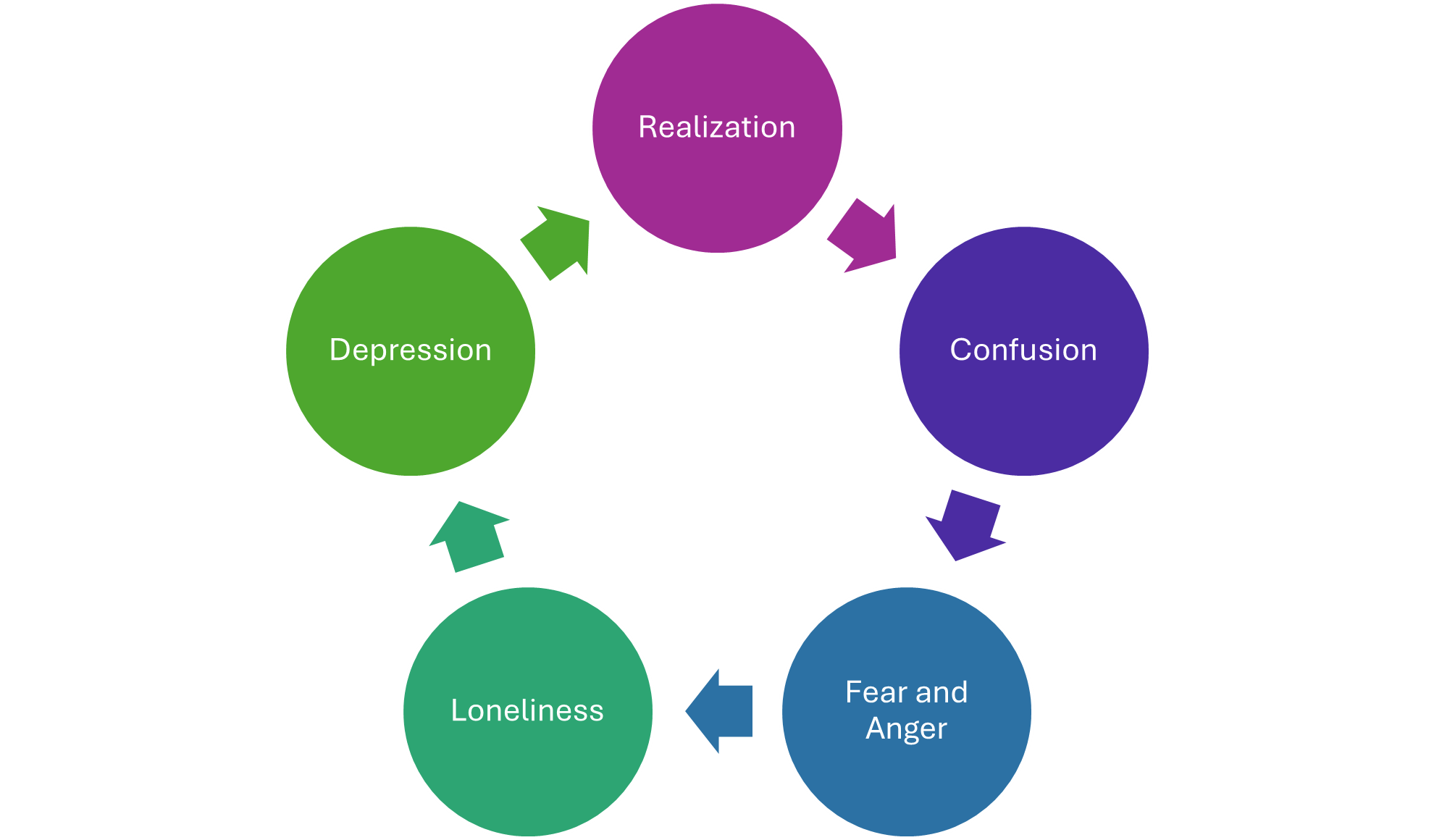
Five stages of being a Care Partner/Caregiver
Looking back over the last few years, I have realized that I have experienced a gambit of emotions. When a health crisis happens to a loved one, it is very similar to a death. The life you have planned has changed and is either no longer possible or needs to be adapted. Fortunately, unlike a death, we still have our loved ones with us.
Whatever stage you are at is absolutely where you need to be. The stages of the caregiver are not linear and change as life changes. You may feel on Monday that you have an accepted and are at peace with your new lifestyle and then on Wednesday have a complete meltdown. That is why it is so important to acknowledge where you are and reach out to others. Please use the comment section below to share.
Looking back over the last few years, I have realized that I have experienced a gambit of emotions. When a health crisis happens to a loved one, it is very similar to a death. Your planned life has changed and is either no longer possible or needs to be adapted. Fortunately, unlike a death, we still have our loved ones with us.
Whatever stage you are at is absolutely where you need to be. The stages of the caregiver are not linear and change as life changes. You may feel on Monday that you have accepted and are at peace with your new lifestyle, and then on Wednesday, have a complete meltdown. That is why it is so important to acknowledge where you are and reach out to others. Please use the comment section below to share.
The stages of caregiving…
Caregiver Stage: Confusion
Confusion is the initial phase for the caregiver. I was confused and unclear about the extent of the stroke and what the potential outcome could be. Each day is a rollercoaster of emotions: anger, fear, and exhaustion. I was overwhelmed but wanted answers. Most of the answers were of the “wait and see” variety from the health professionals and the “God only gives you what you can handle” or “I know someone who had a terrible stroke and is better than before” variety from well-meaning friends and family. But often, all you hear is “Blah, Blah, Blah.”
As a nurse, I didn’t expect to be confused. I knew the aspects of the medical issues related to a stroke, but not the response I would have as a spouse. My mind raced with all my nursing knowledge, nursing friends shared advice and the dreaded internet of information. As a take-charge type, I became frustrated because all I could do was sit back and watch our life fall apart.
The confusion phase started the moment I made the 911 call. I needed very simple answers during the first forty-eight hours. Will he survive? What is the plan for the next hour? What do I tell the kids? Everyone wants to have an update and I came to understand that what they really want is to hear that all is going well, and he is improving.
His health changed every hour so providing an update soon became another source of anxiety. While I was attempting to stay positive about his health and share any good news, the reality was that his health was very touch and go at this time. My main concern was, would he even be with me in twenty-four hours?
Caregiver Stage: Fear and Anger
Fear and anger were the stage when I understood what had happened, but I now began to worry and think, “How can I handle this?” During this phase, the caregiver handles every aspect of their loved one’s life, making all the decisions alone. All the “what ifs” will rear their ugly heads. What if he dies? What if he survives? And how can I ever live without this person?
Once I passed through the confusion phase and had some idea of what I was dealing with, my nursing background and the world of “what ifs” entered the picture. I still didn’t know where we would be in a year poststroke, but I knew enough that it would not be a straightforward journey for either of us. I outlined some fears that I experienced below:
Would Rick recover? How much would he recover? What if he dies? How much should I share with him? Does he understand what is happening? What will our marriage look like?
How can I prepare the children? What if they lose their dad? How will their relationship with Rick change? Do they feel they need to care for us now? How will this affect their families?
Can we handle this financially? How much will this cost? Do I have enough coverage? Will I need to take a leave from work or retire to care for Rick? Am I equipped to make all the family financial decisions?
What is my new role? Am I ready to be the caregiver? Can I take this on without anger and frustration? Why is this happening? Will Rick and I ever have an intimate relationship, physically and emotionally, again?
Caregiver Stage: Loneliness and Depression
I had always considered loneliness sadness due to a lack of friends or company. So, how could I experience loneliness when surrounded by family, friends, and healthcare providers for many weeks and now home with Rick daily.
I learned being lonely, while never alone, is a unique type of loneliness. The world is flying past you with the typical day-to-day issues you thought were important until life priorities changed.
No longer did I care if he remembered a task that I had asked him to do a million times or that he was not as attentive as other spouses seemed to be. He was my world, and I was losing him.
When asked how I was doing, I was at a loss for words. I felt I had no right to complain or feel sorry for myself. He had the stroke, and I was healthy. The answer would always be: “I’m good, just a little tired. I just need to count my blessings.”
With this response, I thought I was protecting myself from dealing with my feelings, but I was pushing others away and closing doors of support. Everyone deals with this stage differently, but I think loneliness, while never alone, is universal when a caregiver.
Caregiver Stage: Realization
More and more days were hopeful for me and less were filled with depression and loneliness,
this is when I finally came to terms with the life we will now have. The stroke was devastating for both of us and after a year, Rick’s recovery had plateaued.
Over a period of about three months, we both became aware that his physical and cognitive limitations were not improving and that we were beginning to adapt our lives around those. The realization of what our future would hold happened for me at the one-year follow-up medical appointment.
When the doctor shared, “He is progressing slowly, but he is moving in the right direction. I can see so much improvement from last year.” The confirmation from a medical professional that we were no longer taking steps backward provided comfort to us. We understood that improvements could happen beyond this point, but the likelihood that they would was low.
The effects of the stroke and the changes in his overall health still needed to be addressed, but I no longer felt hopeless. I started to believe that we could work through any upcoming challenges.
That evening, I took some time alone to discern what our future will look like and how I could handle this long term. My new role as his caregiver was no longer temporary but full-time. What would our marriage be like? Did I have the fortitude to handle this change? What support would be available? How can we flourish in this new life versus wither away?
For more information on what worked for us, check out “Stroke and the Spouse” available on Amazon or follow the code below to purchase.
Stroke Caregiver Connection…Because you care!
The easy way to start the New Year (experts won’t tell you)
We are going into our third-year post stroke. Over these many months, I have had struggles, tears, and frustration but I also have learned so many tips and tools to help handle this life change. Coming to a point of acceptance that this is our new normal, the good and the bad. The first two years, I was in survival mode but this year, I want to flourish in my new role. I want you to also flourish as a caregiver/care partner as well.
As Care Partners of stroke survivors, the best way to start the new year is not by making resolutions but to realistically look at your situation and determine what will bring you joy and happiness.
We are going into our third year post-stroke. Over these many months, I have had struggles, tears, and frustration, but I have also learned many tips and tools to help handle this life change. Coming to a point of acceptance that this is our new normal, the good and the bad. I was in survival mode for the first two years, but this year, I want to flourish in my new role. I want you to also flourish as a caregiver/care partner as well.
As Care Partners of stroke survivors, the best way to start the new year is not by making resolutions but by realistically looking at your situation and determining what will bring you joy and happiness.
There is no cookie-cutter approach, but through trial and error, I would like to share what I have learned over the past years and what is working for me. Let me be realistic, you will still have rough days when you want to give up but know you are not alone. Send me a note in the comments and we can navigate together.
What I realized and what is working for me…
Tip #1: Change my mindset to a Care Partner.
We are not an extension of our loved one’s illness, and we are also not 100% responsible for their care and ongoing health. A distinct difference exists between being a Caregiver and a Care Partner. A Caregiver provides most of the care with limited involvement by the LO. A Care Partner works with the LO for a better life and health outcome.
Initially, I was a Caregiver, but as time passed, I realized that he could do some things, and I was the one holding him back, partially out of fear that he would hurt himself and partially out of habit. That is when I decided that my role is a Care Partner.
This caused me to stop and evaluate what he could do. The LO also gets very used to you providing for all their needs. Each week, I would add a task. As a wife, I must admit that it was tough to let go of control and accept that the task would not be done to my liking. Over time, your standards will lessen as you see them take on more. Start small, folding towels or getting the mail.
Tip #2: Reviewed my calendar.
When I reviewed my calendar from the previous year, I realized it was focused on what my LO needed versus what we, as a couple, needed. Medical appointments aside, our days were very similar. I had not planned for outings, others to support us or time away.
I started at the beginning of each month, blocking out time for social, time for your mental and spiritual growth, time for them alone, and time for you alone. I understand that if your LO cannot be home alone, this is a challenge, but this is when, as a Care Partner, you reach out to family and friends.
Key Point: Don’t ask when others are available to plan. Provide dates and times and ask others to sign up to spend time with your LO. I have adopted a post-stroke philosophy: “I would rather laugh with the living than cry with the dead.” Your friends and family want to support you, just not sure how.
Tip #3: Turn it over to a higher power.
I was doing it all as a Caregiver and not a Care Partner. I felt very alone and exhausted. But I reached a point when I could no longer carry the burden and had to let it go. But who can and will pick me up. This is when I relied on my faith and asked God to be my Care Partner on this journey. I knew I could no longer do it alone, and I did not want to burden my children, family, and friends.
What helped me to turn it over and not feel so alone was that I started my day in prayer. Some days it was to help me through today and others a prayer of gratitude. I also joined a group of women at church that have been a tremendous support.
Tip #4: Rethink a challenge as a blessing.
This is one of the hardest, but it is a game-changer once you make that switch. For us, short-term memory issues are a challenge. I will get frustrated and angry that I am constantly repeating. He will forget to tell me if he plans something with a friend or schedules an appointment.
How to change this into a blessing –
Identify why I would get angry; I know he has short-term memory loss. The blessing is that God has provided friends who want to help, medical staff to improve his care, and options to deal with the issue.
We now have a calendar that he writes everything on. Whenever he finishes a call or returns home, I ask if anything needs to be added. Most medical groups have an application that shares appointments.
As we all get older or stressed, we all forget. Take this challenge and find humor in it.
Tip #5: Start a gratitude jar.
When I wake up each day, I think about what will happen today. I would focus on what went wrong, and I was emotionally and physically exhausted at the end of the day. This tip came from my LO. Post-stroke, he suffers from apathy, and nothing upsets him or causes him any concerns.
One evening, when I was low, he shared all the day's positives and downplayed the issues. He shared that you need to write down a positive each day. So, on Jan. 1, I started my gratitude jar, which has made a difference. When I am down, I reflect on the day to find that positive. As the jar fills, I look at it with a smile and a feeling of contentment.
Have a very happy and joyful 2024!
Stroke Caregiver Connection…Because you care!
Holiday Survival
I love to entertain and have a house full of guest. Rick and I would start planning early. He would decorate the outside and I would do the inside. Like all couples, I did the shopping but we would joke, he was mt last minute man. I could always count on him to run to the store numerous times to get that one ingredient that I forgot. He would laugh and never complain.
The holidays are here and how to not only survive but enjoy them. I love to entertain and have a house full of guest. Rick and I would start planning early. He would decorate the outside and I would do the inside. Like all couples, I did the shopping but we would joke, he was my last minute man. I could always count on him to run to the store numerous times to get that one ingredient that I forgot. He would laugh and never complain.
The holidays have changed since Rick had the stroke, his desire to fully participate has left but he still loves when the kids and grandkids arrive. The first year after the stroke, I set myself up. I was convinced that the holidays didn’t need to change - I could do it all.
I did my best but by January 2, I was tired, crabby and depressed that it didn’t go as planned. So this year, I have a much simpler plan.
Holiday Survival Plan
Review what you want to give. After the year we had, the gift of being together is so much more important than the latest gadget. I was worried that the family would be upset with the change - they were thrilled.
·Shop early and wrap those gifts when you bring them home. This has helped with the last minute crazy of wrapping and also keeping track of what you bought. Every Christmas, I would always have a gift tucked away that I forgot.
Instead of gifts, give experiences. With Rick’s limitations and health scare, memories made will last longer than a gift.
Others love to entertain as well. Be gracious and enjoy the holidays at another’s home. It is a gift to them to be able to celebrate with you.
Decorations at the house. This year, Rick will be supervising the outside lights. Plan a family day to decorate, serve chile and dessert. This will be a new tradition.
Plan for naps. Schedule the holiday celebrations to include rest. Rick can handle about 2 hours at a time in larger groups.
Do not over plan. Not every tradition from the past needs to be carried over. Really, How many cookies do I need to bake and eat? Does dinner need to be a sit down dinner or appetizers through out the day? Do you need to see everyone over those few days? Spread out visits and fun over a longer period of time so that everyone can enjoy.
Lastly, the season is not about what you did but rather the birth of Jesus. Celebrate the love He provides and be grateful for all of your blessings.
Enjoy the holidays! Next post will be 1/2/2024
Stroke Caregiver Connection…Because you care!
Caregiver Burnout
Caregiver burnout is a state of physical, emotional, and mental exhaustion that happens while you’re taking care of someone else. Stressed caregivers may experience fatigue, anxiety, and depression. You can reduce your risk of burnout by participating in respite care, joining a support group, or talking with a mental health professional.
Can you experience caregiver burnout even when you are caring for a spouse or your child? Absolutely, A study published in 2015 determined that women found caring for a spouse or child to be more stressful and more detrimental to mental health than caring for a parent or someone else.
Caregiver burnout is a state of physical, emotional, and mental exhaustion that happens while you’re taking care of someone else. Stressed caregivers may experience fatigue, anxiety, and depression. You can reduce your risk of burnout by participating in respite care, joining a support group, or talking with a mental health professional.
Can you experience caregiver burnout even when you are caring for a spouse or your child? Absolutely, A study published in 2015 determined that women found caring for a spouse or child to be more stressful and more detrimental to mental health than caring for a parent or someone else.
What causes burnout?
For me, too many responsibilities. I now had to not only handle my role in life and work but had to take on his role and responsibilities. Sometimes, caregiving can feel like you’re juggling too many obligations at once. Many caregivers experience stress because they see their role as their sole responsibility, even if it’s too much for one person to realistically handle.
The Cleveland Clinic provides an excellent resource regarding Caregiver Burnout. Let me share some highlights and then what worked for me. For more details…
Burnout Signs and Symptoms…
· Exhaustion – emotional or physical
· Not participating in social activities with friends, family or loved ones.
· Feeling hopeless and helpless
· Not eating or eating too much – weight change
· Not sleeping or sleeping too much
· Unable to concentrate – feeling forgetful or distracted.
· Getting sick more often
· Irritability, frustration, or anger towards others. Especially over minor issues
How it felt…
When my husband came home from rehab, I felt that I had to watch every move to keep him safe. I didn’t want us to be a burden, so I did it all. If I heard him move at night or try to get up, I would jump to attention to help.
Since, as a nurse, he had his stroke on my watch. I was so worried that if I missed something that I could cause him additional harm. My days were filled with anxiety and fear.
What I felt was needed was not at all what he felt. I was the hovering spouse so at times would be frustrated that he would not accept, want, or appreciate the care I provided. He was in denial as to the severity and would constantly state “I’m fine” and avoid activity.
I was struggling as the caregiver but the guilt I carried was heavy. He had the stroke not me so spending time caring for me seemed selfish. At first, I was positive regarding my role but as the days dragged on it became harder and harder to see the light at the end of the tunnel. Because it is what it is. It feels as if a dark cloud is following you.
Lastly, I felt alone. Each day was the same until a crisis hit. I felt family and friends had moved on and I needed to deal with this alone. I didn’t want others to think I couldn’t handle or that he was a burden.
What worked for me…
The amount of stress and emotional weight that comes with being a caregiver can feel overwhelming. It helped me to reach out to my primary doctor and a counselor (many are online, so needed to leave the home to discuss what I was feeling. What I found was that I was not alone, this is not uncommon but we as caregivers are not taught prior to discharge that this will happen and what to do.
I needed to make time for myself. At first, I felt selfish, but that is NOT true, taking care of yourself while you’re taking care of someone else is not selfish at all. I had to let go and ask for support so I could make time for me.
He does not have taste after the stroke so I would nibble for food - Make sure you eat well-balanced meals throughout the day, that made a difference. and get enough sleep. Exercise can improve your mood and you can unwind at the end of each day by meditating or practicing yoga.
Lastly, ask for help. It isn’t easy to ask for help or to accept it. Sometimes, your support system doesn’t recognize the need unless you ask for it. You may need to practice saying “yes” when someone offers you help or no when more tasks fall on your plate. Oftentimes, others will be more than willing to help you pick up groceries if they’re out running errands or walking your dog after they get home from work or school.
Final thoughts - Caregiving is a marathon with good days and not so good days. It is not a sprint that only lasts a short time. Pace yourself
Stroke Caregiver Connection…Because you care!
The Upsides of Ongoing Therapeutic Sessions
After several months, I noticed that Rick’s balance was getting worse, and his speech was getting more garbled. He would try to compensate by using his non affected hand and limiting conversation. He had become comfortable with the status quo. My gut told me there was more that could be done and did some research that I want to share with you. Bottom line --- Don’t give up!!!!
Once Rick had completed his physical, occupational and speech therapy post stroke, I assumed that this was it. This was as good as it gets! I was wrong. About 18 months later, we realized that he was declining. Immediately after discharge from therapy, he could do more and was motivated but as time passed, the motivation and improvements slowed down to a halt. As the caregiver, I gave up on pushing him to improve - He had to be motivated to improve.
Aha Moment
After several months, I noticed that Rick’s balance was getting worse, and his speech was getting more garbled. He would try to compensate by using his non affected hand and limiting conversation. He had become comfortable with the status quo. My gut told me there was more that could be done and did some research that I want to share with you. Bottom line --- Don’t give up!!!!
A study completed by NPR - www.npr.org › study-stroke-recovery-best-treatment
A study of 72 stroke patients suggests this is a "critical period," when the brain has the greatest capacity to rewire.
Regain more hand and arm function if intensive rehabilitation starts two to three months after the injury to their brain.
The idea that there is a critical period when the brain is most able to recover is "something we've suspected all along, based on the animal models," says Dr. Jin-Moo Lee, chair of neurology at Washington University in St. Louis. "But this is really the first human evidence that there's a period in which rehab therapies are most effective in improving recovery."
Solution that worked for me.
I followed the below guidelines from www.stroke.org › rehab-therapy-after-a-stroke Rehab Therapy After a Stroke | American Stroke Association
The American Stroke Association’s Together to End Stroke initiative, nationally sponsored by Kindred Hospital Rehabilitation Services, offers these recovery tips for stroke survivors and their caregivers:
Ask your doctor to assess the physical and cognitive challenges you face after stroke and provide a specific plan to address each challenge.
We met with our MD and discussed a plan. He provided an order for Physical Therapy and Speech Therapy.
The plan was to improve balance and walking. The initial rehab goal was for him to be able to walk well enough to get home. Now he was ready to be able to learn better walking skills.
The second plan was to improve his speech. He was able to be understood but he avoided conversation.
Start your personalized rehabilitation program as soon as your medical team gives you the OK. Early rehabilitation matters. Recovery can take years, but the most rapid progress usually occurs during the first three months after a stroke.
The early rehab helped but now after being home, we needed to address the deficits that needed finetuning.
Met with a PT and she addressed the concerns. He will always have to think about walking, but she taught him to properly walk, exercises to improve balance and motivation to work to not give up.
Met with a ST and she addressed the concerns. She was excellent in providing support to improve his communication – slow his speech, practice words and phrases that are difficult and to not stop.
After a few weeks of therapy, I noticed an improvement in his abilities but more importantly he had a renewed sense that he could improve certain aspects. We both understand that what he lost with the stroke will never return 100%, any small improvement makes a BIG difference.
Financial Coverage:
Private Insurance –
Most plans have a yearly therapy benefit that requires a physician’s order. It is not unusual to have a copay. Contact your insurance carrier or your policy to determine your benefits.
Medicare (Based on Medicare 2024 Official Handbook – see Section 2 page 48)
Physical therapy services
Medicare covers evaluation and treatment for injuries and diseases that change your ability to function, or to improve or maintain current function or slow decline, when your doctor or other health care provider, including a nurse practitioner, clinical nurse specialist or physician assistant certifies you need it. You pay 20% of the Medicare-approved amount. The Part Bdeductible applies.
Occupational therapy services
Medicare covers medically necessary therapy to help you perform activities of daily living (like dressing or bathing). This therapy helps to improve or maintain current capabilities or slow decline when your doctor or other health care provider certifies you need it. You pay 20% of the Medicare-approved amount. The Part B deductible applies.
Speech-language pathology services
Medicare covers medically necessary evaluation and treatment to regain and strengthen speech and language skills. This includes cognitive and swallowing skills, or to improve or maintain current function or slow decline, when your doctor or other health care provider certifies you need it. You pay 20% of the Medicare-approved amount. The Part B deductible applies.
Stroke Caregiver Connection…Because you care!